Building the L&D Credibility with the C-Suite
Executives operate in a world of business outcomes, not learning activities. Building C-suite credibility requires a vital shift—translating learning metrics into the language of revenue, productivity, and risk management. Read our guide to framing your learning roadmap as a business solution, bridging the communication gap, and transforming L&D from a cost center into an indispensable strategic ally.
Hazie Halim
7/14/20264 min read

When Learning Conversations Meet Business Conversations
Most L&D professionals have experienced some version of this moment.
You walk into a meeting with senior leaders, armed with enthusiasm, carefully designed slides, and a learning roadmap you believe will genuinely help the organisation grow.
Five minutes into the presentation, someone from the C-suite asks: “So, how does this impact revenue, productivity, or risks?”
And suddenly, the conversations shifted. Not because executives do not value learning. In fact, many leaders genuinely believe people development matters. But the C-suite operates in a world of business outcomes, not learning activities.
Building credibility with them requires a subtle but important shift: learning conversations must translate into business conversations.
What Executives Actually Care About
Executives typically spend their days thinking about questions like - How do we grow revenue? How do we improve productivity? How do we retain talent? How do we stay competitive? How do we reduce risks? Learning in their minds, is valuable when it helps solve one of these problems.
So, when L&D presents a program titled “Advanced Communication Workshop”, executives may wonder, “why does this matter to the business?”.
But, if the same initiative is framed as “Improving client communication to reduce escalation cases and strengthen customer retention.”, the conversation immediately feels relevant.
It is not learning itself that changes. It is the context.
Presenting Learning Strategy in a Way the C-Suite Understands
When presenting to senior leaders, the goal is not to impress them with the sophistication of learning design. The goal is to show how learning supports organisational performance.
A helpful structure when presenting learning strategy is to focus on three elements:
1. Start with the Business Challenge
Begin with the problem the organisation is facing. For example:
Declining customer satisfaction
Leadership pipeline gaps
Digital transformation challenges
Skill shortages in critical roles
When learning is framed as a response to a real business issue, attention naturally increases.
2. Connect the Capability Gap
Next, identify the capability needed to address that challenge. For instance:
Stronger coaching skills for managers
Better data literacy across teams
Improved consultative selling techniques
This step positions L&D not as a training provider, but as a capability builder.
3. Show the Expected Outcome
Finally, explain what success might look like. Examples could include:
Improved employee engagement scores
Faster onboarding productivity
Increased sales conversion rates
Reduced operational errors
This closes the loop between learning and business impact.
Translating L&D Language into Business Language
One of the most common barriers between L&D and the C-Suite is language.
L&D professionals often use terms that make perfect sense within the learning community, but sound unfamiliar in executive decisions. For example:
Instead of saying “participants will complete a blended learning journey”, try saying “this initiative will strengthen managers’ ability to coach their teams, which supports employee engagement and retention.”
Instead of saying, “we delivered 10,000 learning hours”, try saying “we supported the development of three critical capabilities aligned with our growth strategy.”
The goal is not to abandon learning terminology entirely. It is simply to anchor it in outcomes that executives recognise.
The Human Side of Executive Conversations
It is also worth remembering that executives are human. They operate under intense pressure, constant decision-making, and limited time.
When L&D communicates clearly, concisely, and with genuine understanding of business priorities, trust begins to build.
You do not need complicated jargon or elaborate presentations. Often, when resonates most is a simple, well-framed insights such as “we’ve identified a capability gap that could affect our ability to scale next year, and here is how we plan to address it.”
That level of clarity speaks volume.
When L&D Becomes a Strategic Voice
When learning strategy connects naturally with organisational strategy, something interesting happens. L&D is no longer invited to meetings just to discuss training logistics. Instead, it becomes part of conversations about growth, talent development, and future readiness.
That shift transforms perception.
L&D stops being viewed as a cost center running programs. It becomes a partner shaping capability. And perhaps the most reassuring part of this journey is that credibility rarely comes from grand gestures. It comes from small, consistent signals that learning understands the business.
Once that understanding becomes visible, the C-suite starts to see L&D not as a support function.
But as a strategic ally.
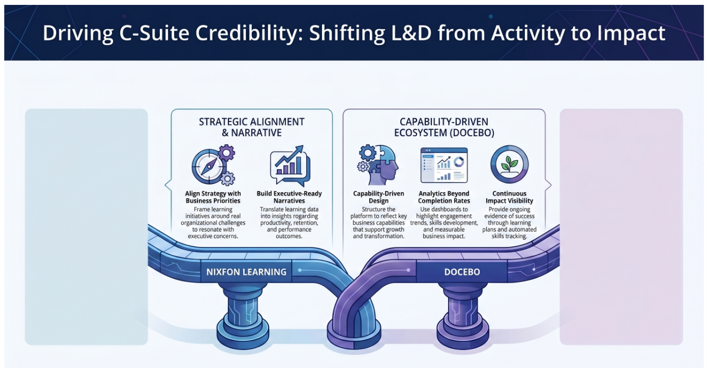
How Nixfon Learning and Docebo Support L&D Credibility with the C-Suite
At Nixfon Learning, we understand that credibility with the C-suite is not built through presentations alone. It is built through consistent alignment between learning initiatives and business outcomes, supported by clear data, meaningful insights, and the right platform capabilities.
This is where the combination of strategic guidance and Docebo LMS becomes powerful.
We support L&D teams in bridging the gap between learning activity and business impact, ensuring that conversations with leadership are grounded in relevance, not just intention.
We recognise that credibility is not a one-time achievement. It is built over time, through consistent signals that L&D understands the business and can demonstrate its contribution clearly.
At Nixfon Learning, we help organisations use Docebo not just as a learning platform, but as a strategic enabler, so that L&D conversations with the C-suit shift naturally from “what we are delivering” to “how we are driving impact”.
Till we meet again in the next episode!
About the author
Hazie Halim has more than 15 years of experience in Talent Management Solution and L&D Tech. Her approach has never been about the technology; it has always been about the people in the industry. She understands HR & L&D, she understands the pain and the stress, and she understands the fear and reluctance of system integration drama. Combining these has allowed her to be compassionate when sharing her experience and knowledge during project implementation. She is passionate about making the HR & L&D experts look good in front of their stakeholders. Their win is her win.


Unlock a world of thrilling content
Join our newsletter today
Resources


Unit 7.06, Level 7, Amcorp Trade Centre, 18, Persiaran Barat, 46050 Petaling Jaya, Selangor.
Nixfon (M) Sdn Bhd (633379-V)