Data Integration in L&D – Why It Sounds Scary (And Why It Shouldn’t Be)
Data integration isn't about technical complexity; it's about connection. Stop wasting hours on manual administrative tasks and learn how to make your learning ecosystem work quietly in the background. Read our guide to overcoming data intimidation, starting small with your LMS infrastructure, and transforming integration into a strategic enabler for your organization.
Hazie Halim
6/25/20264 min read
There is a moment in almost every LMS or learning transformation project where the room becomes a little quieter.
Someone says, “We’ll need to integrate with HR systems, performance platforms, and maybe CRM…”
And suddenly, L&D professionals feel like they’ve stepped into a different language entirely. APIs. Data mapping. Sync schedules. System architecture. It can feel like you’ve accidentally walked into an IT meeting without a translator.
But here’s the truth, gently and clearly: Data integration is not something L&D needs to fear. It’s something L&D needs to understand just enough to lead well.
Why Data Integration Feels So Intimidating
Let’s acknowledge the discomfort first. Because the fear is real, and it’s common.
1. “It sounds too technical for me.”
Integration conversations often come wrapped in technical language. For L&D teams whose expertise lies in people, learning design, and capability development, this can feel unfamiliar.
It’s not lack of capability. It’s simply a different domain.
1. “What if we get it wrong?”
There is a quiet pressure behind integration decisions. What if data flows incorrectly? What if learners are assigned the wrong content? What if reports become unreliable?
Because data feels permanent. Mistakes can feel expensive.
2. “We don’t fully control this”
Integration usually involves IT teams, vendors, and multiple systems. L&D is no longer working independently.
And when ownership feels shared, clarity can sometimes feel blurred.
3. “It sounds like a big, complex project”
Integration is often introduced as major milestone. Something that feels heavy, technical, and time-consuming.
And naturally, anything that feels big and unfamiliar tends to feel intimidating.
A Gentle Reframe: What Integration Really Is
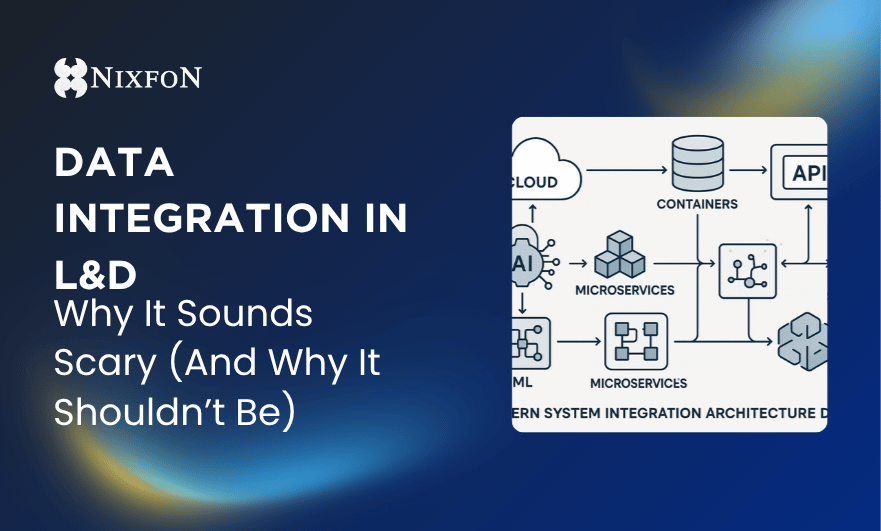
Let’s simplify it. At its core, data integration is just this: helping systems talk to each other so people don’t have to do manual work. That’s it.
HR system sends employee data -> LMS creates user profiles.
LMS tracks learning -> data flows into reporting tools
Systems update automatically -> less admin, fewer errors
Integration is not about complexity. It’s about connection. And when they viewed this way, it becomes far less intimidating.
How L&D Can Overcome These Fears
You don’t need to become technical experts. You just need clarity in the right places.
1. Focus on “What” and “Why”, not “How”
L&D’s role is not to build integration. It is to define what success looks like. Ask:
What data do we need?
Why does it matter?
How will it improve the learner experience?
Let IT handle the “how”. You can own the “purpose”.
1. Start small, not everything at once
One of the biggest mistakes organisations make is trying to integrate everything immediately. Instead, prioritise:
User data (basic profiles, roles)
Organisational structure
Essential reporting flows
Build the foundation first. Expand later.
2. Collaborate early with IT
Integration works best when L&D and IT are aligned from the beginning. Not in separate conversations. Not in different timelines. But together asking:
What is possible?
What is necessary?
What is realistic?
Clarity early prevents confusion later.
3. Accept that it evolves
Integration is not a “set once and forget” process. Systems change, business needs evolve, and data requirements grow. And that’s okay. Think of integration as something that matures over time, not something that must be perfect from day one.
Managing Integration Strategically
Here’s where L&D steps into a more strategic role. Because integration decisions directly affect learner experience, data quality, reporting accuracy, and operational efficiency.
A thoughtful approach includes:
Clear data ownership – who is responsible for what
Defined data flows – what moves where, and when
Simple governance – how changes are managed
Continuous validation – ensuring accuracy over time
Integration is not just technical plumbing. It is part of your learning ecosystem design. And when designed well, it becomes invisible. Things just… work.
When Integration Stops Feeling Scary
Something interesting happens once integration is in place. Manual processes reduce. Errors decrease. Data becomes more reliable. And learners experience smoother journeys.
And what once felt intimidating becomes something quietly valuable. Like electricity in a room, you don’t think about it, but everything works because of it.
How Nixfon Learning and Docebo Support Integration for L&D
At Nixfon Learning, we understand that integration can feel overwhelming, especially when it sits outside the traditional comfort zone of L&D. That is why we focus on making the process clear, structured, and aligned with what truly matters, the learner experience and business outcomes.
Together with Docebo LMS, we support organisations in approaching integration not as a technical burden, but as a strategic enabler.
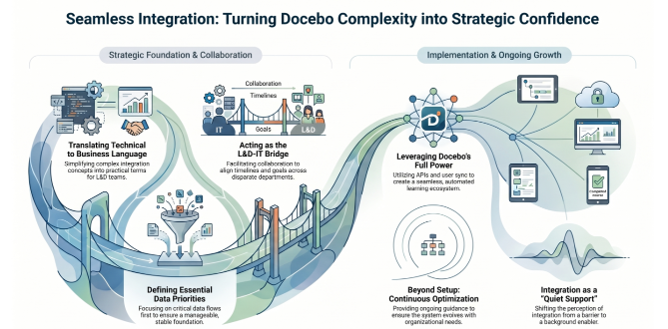
We believe integration should not feel like a barrier. It should feel like quiet support in the background.
At Nixfon Learning, we walk alongside L&D teams through this journey, turning something that once felt complex into something manageable, meaningful, and even… a little less scary.
And perhaps, that is the real shift. Not removing complexity entirely but making it understandable enough to move forward with confidence.
Till we meet again in the next episode!
About the author
Hazie Halim has more than 15 years of experience in Talent Management Solution and L&D Tech. Her approach has never been about the technology; it has always been about the people in the industry. She understands HR & L&D, she understands the pain and the stress, and she understands the fear and reluctance of system integration drama. Combining these has allowed her to be compassionate when sharing her experience and knowledge during project implementation. She is passionate about making the HR & L&D experts look good in front of their stakeholders. Their win is her win.


Unlock a world of thrilling content
Join our newsletter today
Resources


Unit 7.06, Level 7, Amcorp Trade Centre, 18, Persiaran Barat, 46050 Petaling Jaya, Selangor.
Nixfon (M) Sdn Bhd (633379-V)