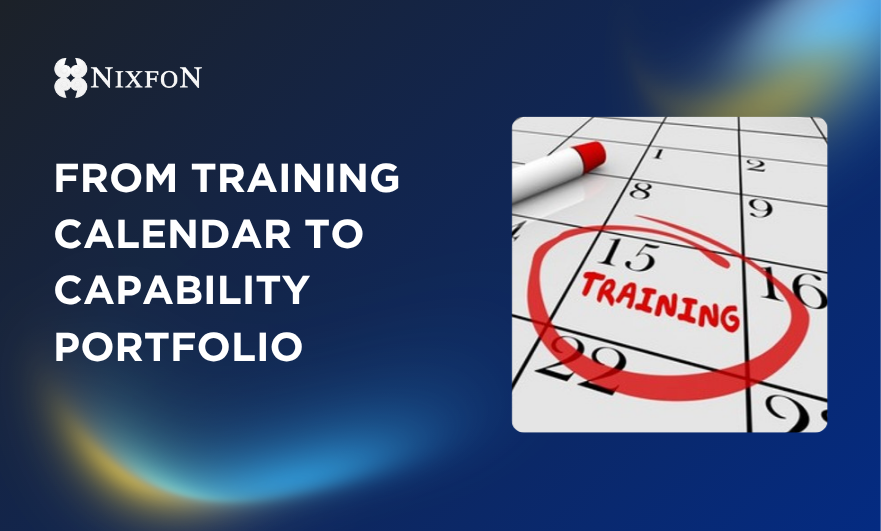
From Training Calendar to Capability Portfolio
Neatly organized training calendars look busy, but when business strategy shifts mid-year, a rigid schedule can't keep up. True agility requires moving from a calendar of events to a dynamic capability portfolio. Read our guide to breaking free from the scheduling routine, designing layered development pathways, and transforming your learning infrastructure into a strategic engine that architects real growth.
Hazie Halim
7/9/20264 min read
Why L&D Needs to Stop Scheduling and Start Architecting
Open any L&D shared drive, and you will probably find it. A neatly organised spreadsheet titled: “2026 Training Calendar”.
January – Communication Skills
March – Leadership Essentials
June – Customer Service Excellence
September – Time Management
It looks organised. Responsible. Busy. But here is a quiet question worth asking – If business strategy shifts in April, does the calendar shift with it? Or does it politely continue as planned?
The traditional training calendar has served L&D for years. It helps with budgeting, scheduling, and logistics. It provides structure.
But structure is not the same as strategy. And this is where the idea of a capability portfolio becomes powerful.
What Is a Training Calendar
A training calendar is event focused. It answers:
What sessions will run this year?
When will they run?
Who will attend?
It is operationally useful. But it is often disconnected from evolving business priorities. The risk is subtle. L&D becomes a scheduler program instead of a shaper of performance.
What is a Capability Portfolio
A capability portfolio shifts the focus from events to outcomes. Instead of listing courses by month, it identifies:
Critical organisation capabilities
Prioritise skill clusters
Investment levels by capability
Target audience segments
Measurable outcomes
It answers:
What capabilities must we strengthen to execute the strategy?
Where are our highest risks?
How are we developing these capabilities over time?
A portfolio thinks in terms of capability themes, not isolated workshops. For example, instead of “Run 4 leadership programs”, you define “Strengthen coaching capabilities across all mid-level managers within 12 months”.
That is a strategic shift.
Why This Transition Matters
1. Business Agility
Markets shift. Digital initiatives accelerate. Customer expectations evolve. A fixed calendar struggles to respond quickly. A capability portfolio allows L&D to reallocate focus and resources toward emerging priorities without dismantling the entire structure.
1. Stronger Executive Alignment
Leaders rarely think in terms of workshops. They think in terms of revenue growth, productivity, risk management, and talent retention. When L&D presents a capability portfolio aligned to these goals, conversations become more strategic. It moves from “Can we approve this program?”, to “How are we building this capability?"
2. Smarter Resource Allocation
Not all capabilities deserve equal investment. A portfolio approach forces prioritisation. It asks:
Which capabilities are mission-critical?
Which are supportive?
Which can be phased over time?
This prevents spreading resources thinly across too many disconnected initiatives.
How L&D Professionals Can Make the Shift
Transitioning from calendar to portfolio is not about deleting a spreadsheet. It requires thoughtful steps.
1. Step 1: Clarify Strategic Capabilities
Start with business strategy. Identify 3 to 5 core capabilities that will determine success over the next 2 to 3 years. Examples might include:
Digital fluency
Consultative selling
Change leadership
Data-driven decision making
These become the pillars of your portfolio.
2. Step 2: Map Existing Programs to Capabilities
Review your current training offerings. Ask “Which capability does each program support?”. You may discover that some programs overlap, some capabilities are underdeveloped, and some sessions exist out of tradition rather than necessity.
This clarity is liberating.
3. Step 3: Design Capability Pathways
For each priority capability, define:
Target audience
Progressive learning stages
Reinforcement mechanisms
Measurement approach
Instead of a single event, design layered development. For example:
Awareness session → Practice simulation → Manager coaching → Performance management.
Capability grows through reinforcement, not exposure.
4. Step 4: Shift the Reporting Narrative
When presenting to leadership, move from, “Here are the 20 programs we are running this year,” to “Here are the 4 critical capabilities we are strengthening, and here is how we are doing it.”
This subtle reframing elevates perception.
The training calendar organises activity. The capability portfolio architects growth. Both have their place. But in the world of constant change, organisations do not need more scheduled sessions. They need stronger capabilities.
And L&D is uniquely positioned to design them. The question is not whether the calendar serves the capability strategy.
When it does, L&D stops filling dates. They start to shape direction.
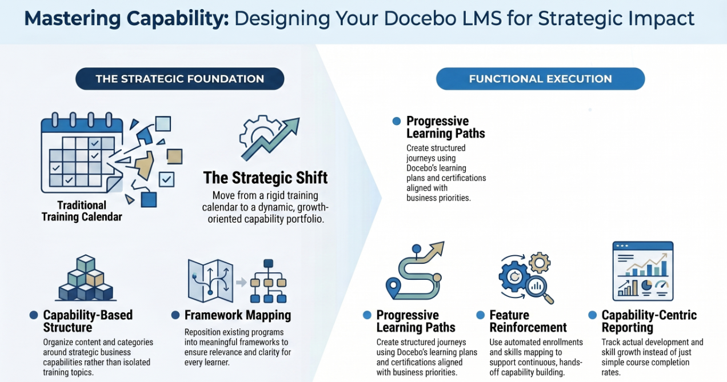
How Nixfon Learning Supports This Shift Through Docebo LMS
At Nixfon Learning, we understand that shifting from a training calendar to a capability portfolio requires more than a change in mindset. It requires the right platform design to bring that strategy to life.
With Docebo LMS, organisations have the flexibility to move beyond scheduling courses and start structuring learning around capabilities. However, without a clear approach, the platform can easily mirror the same calendar model it was meant to evolve from.
This is where we support L&D teams in translating strategy into a well-designed Docebo environment.
We recognise that technology should enable strategy, not limit it.
At Nixfon Learning, we help organisations design their Docebo LMS in a way that reflects a capability-driven approach, so that the platform becomes more than a place to manage training. It becomes a space where capabilities are intentionally built, tracked, and strengthened over time.
Till we meet again in the next episode!
About the author
Hazie Halim has more than 15 years of experience in Talent Management Solution and L&D Tech. Her approach has never been about the technology; it has always been about the people in the industry. She understands HR & L&D, she understands the pain and the stress, and she understands the fear and reluctance of system integration drama. Combining these has allowed her to be compassionate when sharing her experience and knowledge during project implementation. She is passionate about making the HR & L&D experts look good in front of their stakeholders. Their win is her win.


Unlock a world of thrilling content
Join our newsletter today
Resources


Unit 7.06, Level 7, Amcorp Trade Centre, 18, Persiaran Barat, 46050 Petaling Jaya, Selangor.
Nixfon (M) Sdn Bhd (633379-V)