Gamification in LMS: Is It a Bribe, or a Brilliant Strategy?
Is your LMS gamification strategy a brilliant behavioral driver, or just an expensive bribe for attention? Stop rewarding empty clicks and start gamifying real capability development. Read our guide to transforming points and badges into a quiet engine for intrinsic motivation, using your Docebo LMS to make continuous learner progress highly visible and rewarding.
Hazie Halim
6/30/20264 min read
Let’s be honest for a moment.
You log into an LMS and see this: “Complete this course and earn 50 points!” or “Unlock a badge when you finish all modules!”
And somewhere in the back of your mind, a tiny voice whispers, “Are we… bribing people to learn?”
It’s a fair question. And one that many L&D teams quietly wrestle with. Because when gamification is done poorly, it does feel like a trade. “You give me your attention; I give you points.” But when done well? It becomes something entirely different. Not a bribe. A spark.
Let’s unpack that.
The Real Purpose of Gamification
Gamification is not about turning learning into a game. It’s about borrowing what makes games engaging and applying it to learning.
Games work because they provide clear goals, immediate feedback, a sense of progress, and small wins along the way. And most importantly, they make people what to continue.
In learning, this matters more than we admit. Because the biggest challenge is rarely access to content. It’s sustained engagement. Gamification when done used thoughtfully, helps answer a simple question: “How do we keep learners coming back?”
When Gamification Feels Like a Bribe
Let’s call it out clearly. Gamification does feel like a bribe when:
Points are given without meaning
Badges don’t represent real achievement
Rewards are disconnected from capability
Learners chase points instead of learning
In these cases, gamification becomes surface-level decoration. It may create short bursts of activity, but it rarely leads to meaningful development. It’s like giving someone a gold star for opening a book, not for understanding it.
And learners are smarter than we think. They know the difference.
When Gamification Actually Works
Now here’s where it gets interesting. Gamification works beautifully when it reinforces progress, not just participation.
When designed well, it taps into something deeper:
The satisfaction of completing a challenge
The motivation to move to the next level
The quiet pride of mastering something
Instead of “Do this to get reward”, it becomes “I want to see how far I can go”.
That shift is everything.
What effective gamification looks like:
Progression-based learning – learners move through levels or stage that reflect real development
Meaningful achievements – badges represent capabilities, not just completion
Visible growth – learners can see how far they’ve come and what’s next
Healthy competition (optional, not forced) – leaderboards can motivate, but should never discourage
Gamification at its best doesn’t distract from learning. It amplifies it.
Motivation: The Real Game
Here’s the deeper truth. Gamification is not about points. It’s about motivation. And motivation comes in two forms:
1) Extrinsic – rewards, points, recognition
2) Intrinsic – curiosity, mastery, personal growth
Poor gamification relies only on extrinsic motivation. Great gamification uses extrinsic elements to unlock intrinsic motivation.
For example:
A badge signals progress – builds confidence
Progress tracking shows improvement – fuels momentum
Small wins reduce overwhelm – encourages continuation
Suddenly, learners are not just completing courses. They are investing in themselves.
The Importance of Right Implementation
Here’s where many organisations get it wrong. They turn on gamification features and stop there. But gamification is not a switch. It’s a design strategy. Without thoughtful implementation, it becomes noise. With the right design, it becomes a behavioural driver.
Key principles for successful gamification:
Align with capability, not activity – reward skill development, not just clicks
Keep it simple and meaningful – too many mechanics can confuse rather than engage
Integrate into learning journey – gamification should support pathways, not sit separately
Communicate purpose clearly – learners should understand why it exists, not just how it works
Monitor and adapt – what motivates one group may not work for another
Gamification is not about making learning ‘fun’ for the sake of it. It’s about making progress visible, rewarding, and continuous.
So, is it a bribe? It can be. But only when it’s treated as a shortcut. When gamification is used with intention, it becomes something far more powerful. A guide, a motivator, and a quiet engine that keeps learning moving.
And perhaps, the better question is not whether gamification is a bribe, but whether we are using it to reward activity, or to support growth.
How Nixfon Learning and Docebo Support Gamification Strategy
At Nixfon Learning, we understand that gamification is not about adding features. It is about designing behaviour.
We work with organisations to ensure gamification supports real learning outcomes, not just short-term engagement. Together with Docebo LMS, we help L&D teams implement gamification in a way that is structured, meaningful, and aligned with business goals
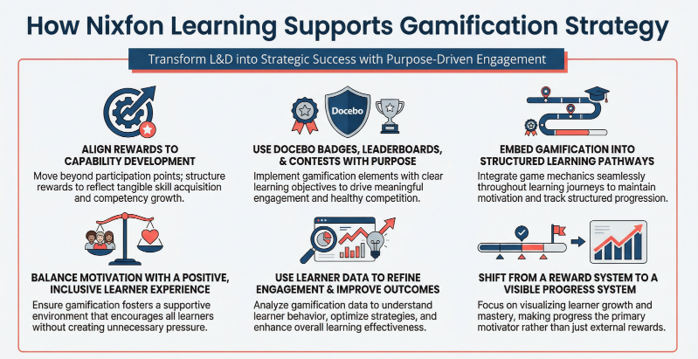
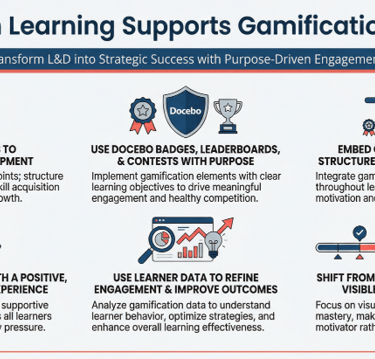
We believe that gamification should feel less like a reward system and more like a progress system.
At Nixfon Learning, we help organisations design gamified learning experiences that do not just attract attention but sustain growth.
Because when learners feel progress, they don’t need to be bribed. They choose to continue.
Till we meet in the next episode!
About the author
Hazie Halim has more than 15 years of experience in Talent Management Solution and L&D Tech. Her approach has never been about the technology; it has always been about the people in the industry. She understands HR & L&D, she understands the pain and the stress, and she understands the fear and reluctance of system integration drama. Combining these has allowed her to be compassionate when sharing her experience and knowledge during project implementation. She is passionate about making the HR & L&D experts look good in front of their stakeholders. Their win is her win.


Unlock a world of thrilling content
Join our newsletter today
Resources


Unit 7.06, Level 7, Amcorp Trade Centre, 18, Persiaran Barat, 46050 Petaling Jaya, Selangor.
Nixfon (M) Sdn Bhd (633379-V)