Incorporating the 70:20:10 Learning Framework: Because Employees Rarely Become Experts from Slide 47 Alone
Training doesn't end when the workshop finishes—true learning happens on the job. Discover how the 70:20:10 framework helps L&D teams design continuous, impactful learning ecosystems that go far beyond the LMS library.
Hazie Halim
7/23/20265 min read
Every L&D professional knows this quiet reality.
An employee attends a beautifully designed workshop. The facilitator is engaging. The slides are polished. The feedback forms sparkle with comments like “Great session!” and “Very insightful.” Then, three weeks later, somebody still forgets how to handle customer escalation and accidentally replies-all to an email that absolutely should not have replied-all to.
This is not because formal learning is ineffective. It is because workplace capability is rarely built through formal learning alone.
People learn by doing. By observing. By asking awkward questions in Teams chat. By surviving difficult projects. By watching managers handle pressures. By making mistakes and quietly hoping nobody noticed.
This is exactly where the 70:20:10 learning framework continues to remain relevant in modern L&D strategy. Not because it is trendy, but because is reflects how humans actually learn at work.
What is the 70:20:10 Learning Framework?
The 70:20:10 framework suggests that employees develop skills and knowledge through these primary sources:
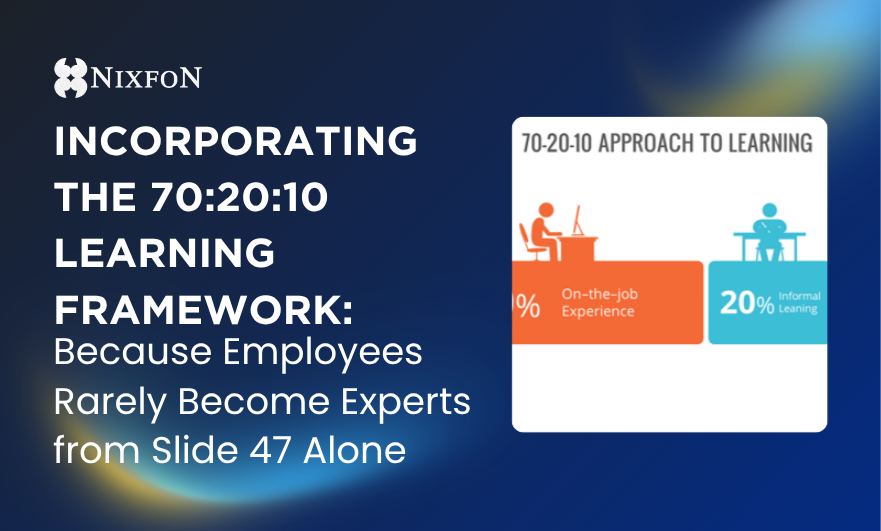
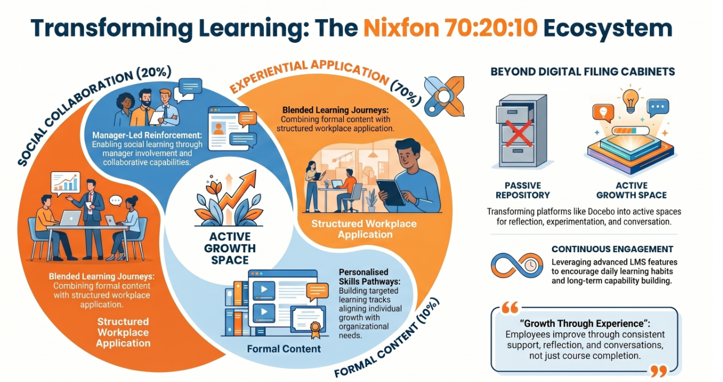
70% through experiential learning – learning by doing, applying, solving problems, and handling real workplace experiences
20% through social learning – learning through managers, peers, coaching, mentoring, collaborations, and feedback
10% through formal learning – structured learning such as workshops, courses, certifications, e-learning, and classroom training
The framework was originally developed by researchers at the Center for Creative Leadership after studying how successful leaders developed professionally. What makes the model powerful is not the exact percentage themselves. It is the mindset shift behind it.
It reminds organisations that learning does not only happen inside training rooms or LMS platforms. A large portion of learning happens in the messy, unpredictable theatre of real work itself.
Why the 70:20:10 Framework Matters More Than Ever
Modern employees are overwhelmed with information. Attention spans are shorter. Work environments are faster. And frankly, many employees no longer have the patience to sit through three-hour training sessions filled with 82 slides and one activity involving sticky notes. Employees want learning that feels connected to their actual work.
This is where the 70:20:10 framework becomes valuable. It creates a more realistic, human-centred learning ecosystem where employees are continuously developing through experience, relationships, and structured support.
Because let’s be honest. Most people remember the difficult client project they survived far more vividly than the eleventh compliance module they clicked through while eating lunch.
How the Framework Improves Learning Engagement
One of the biggest challenges in L&D today is not access to learning. It is sustained engagement.
Employees disengage when learning feels disconnected from their realities. The 70:20:10 framework helps solve this by making learning feel more integrated into daily work instead of something “extra” added onto already overloaded calendars.
Here is why it works:
1) Experiential Learning Creates Relevance - When employees apply skills immediately through projects, stretch assignments, simulations, or real business challenges, learning becomes practical instead of theoretical. People engage more deeply when they can see direct impact.
2) Social Learning Creates Accountability – Learning becomes more meaningful when managers, mentors, and peers are involved. Conversations reinforce learning far better than passive content consumption. Sometimes one thoughtful manager conversation does more for employee growth than an entire leadership webinar series.
3) Formal Learning Creates Structure – Formal learning still matters. It provides foundational knowledge, frameworks, and consistency. But within the 70:20:10 model, formal learning becomes the starting point, not the entire strategy.
How the 70:20:10 Framework Supports Business Objectives
This is where the framework becomes particularly important for organisational leaders. The 70:20:10 approach helps connect learning directly to business performance rather than treating L&D as a standalone activity. When implemented effectively, organisations can:
Accelerate workforce capability development
Improve employee adaptability during change
Strengthen leadership pipelines
Encourage knowledge sharing across teams
Reduce dependency on external hiring
Improve employee retention and internal mobility
Most importantly, it helps create a learning culture where development happens continuously instead of only during scheduled training events. And in environments where business priorities shift rapidly, continuous learning becomes operationally critical.
According to World Economic Forum Future of Jobs report, employers increasingly prioritise reskilling and upskilling as workforce disruption accelerates globally. The organisations that thrive will not necessarily be the ones with the most training content. They will be the ones that build learning into everyday work behaviours.
How L&D Can Incorporate 70:20:10 into Learning Design
The good news is that many L&D teams are already doing parts of this framework naturally. The opportunity is to make it more intentional and structured.
Here are practical ways to incorporate the model into learning strategy:
1. Design Learning Beyond Courses
Instead of ending learning after a workshop, extend it into workplace application. For example:
Assign post-training challenges
Create workplace projects
Encourage reflection journals
Introduce action learning tasks
Learning should continue after the completion badge appears.
2. Equip Managers as Learning Enablers
Managers influence employee learning more than many organisations realise. Provide managers with:
Coaching guides
Reflection prompts
Team discussion questions
Learning reinforcement toolkits
A five-minute manager conversation can reinforce learning far better than another reminder email titled “Gentle Follow-Up #4.”
3. Build Social Learning Opportunities
Encourage:
Peer learning circles
Mentoring programmes
Collaborative projects
Communities of practice
Knowledge-sharing sessions
Employees often learn best from people navigating similar challenges.
4. Use LMS Platforms to Connect the Entire Ecosystem
Modern LMS platforms can support far more than course delivery. With the right implementation, organisations can:
Track learning journeys
Encourage social contributions
Deliver microlearning
Support coaching activities
Recommend personalised learning paths
Connect formal and informal learning experiences
The LMS becomes less of a content library and more of a learning environment.
How Nixfon Learning Supports the 70:20:10 Framework
At Nixfon Learning, we believe learning should not feel isolated from work. It should live naturally within it.
That is why our LMS implementation approach goes beyond simply deploying courses onto a platform. We help organisations design learning ecosystems that support experiential, social, and formal learning together.
Using platforms such as Docebo, we help organisations create learning environments that feel less like digital filing cabinets and more like active space for growth, collaboration, and capability building.
Because ultimately, employees do not become better at their jobs simply by completing courses. They grow through experiences, conversations, experimentation, reflection, and consistent support along the way.
The 70:20:10 framework simply gives L&D a smarter way to design for that reality.
Till we meet again in the next episode!
About the author
Hazie Halim has more than 15 years of experience in Talent Management Solution and L&D Tech. Her approach has never been about the technology; it has always been about the people in the industry. She understands HR & L&D, she understands the pain and the stress, and she understands the fear and reluctance of system integration drama. Combining these has allowed her to be compassionate when sharing her experience and knowledge during project implementation. She is passionate about making the HR & L&D experts look good in front of their stakeholders. Their win is her win.


Unlock a world of thrilling content
Join our newsletter today
Resources


Unit 7.06, Level 7, Amcorp Trade Centre, 18, Persiaran Barat, 46050 Petaling Jaya, Selangor.
Nixfon (M) Sdn Bhd (633379-V)