Investing in L&D Professionals – The Smartest Business Investment Nobody Talks About Enough
While businesses invest heavily in new technology, they often underinvest in the very people responsible for preparing the workforce to use it. Modern L&D professionals have moved far beyond training coordination—acting as skills architects and strategic workforce advisors. Read our guide to recognizing L&D as a vital business capability, avoiding skills disruption, and fueling long-term organizational agility.
Hazie Halim
7/21/20264 min read
There was a time when Learning & Development was often viewed as the department that organised workshops, booked training rooms, and reminded employees to complete compliance modules before Friday at 5PM.
Today, that version of L&D is about as relevant as a fax machine with motivational quotes attached to it.
Modern organisations are operating in a landscape where skills expire faster than office coffee disappears on a Monday morning. Technology evolves quarterly. Roles change constantly. Entire business models pivot overnight. Yet many organisations are still underinvesting in the very people responsible for preparing the workforce for all of it: L&D professionals.
The conversation around workforce transformation often focuses on technology investments. AI adoption, or leadership development. But there is a quieter strategic question sitting underneath all of these initiatives: Who is actually helping the organisation prepare humans for the future of work?
That answer increasingly belongs to L&D professionals.
L&D Professionals Are No Longer “Training Coordinators”
The modern L&D professional wear multiple hats simultaneously. Strategist, skills architect, workforce advisor, performance consultant, data interpreter, and sometimes, part therapist during organisational change.
They are no longer simply delivering courses. They are helping organisations answer critical business questions such as:
What skills will we lack in two years?
Which roles are becoming obsolete?
Where are our capability gaps?
How do we retain high performance through growth opportunities?
How do we prepare managers to lead through uncertainty?
In many ways, L&D has quietly become one of the closest functions to the future of the business.
According to LinkedIn Workplace Learning Report, organisations with strong learning cultures are significantly more likely to improve retention, internal mobility, and overall business adaptability. That matters because adaptability is no longer a “nice leadership word” used in town halls. It has become an operational requirement.
Why CEOs, CFOs, and CHROs Should Pay Attention
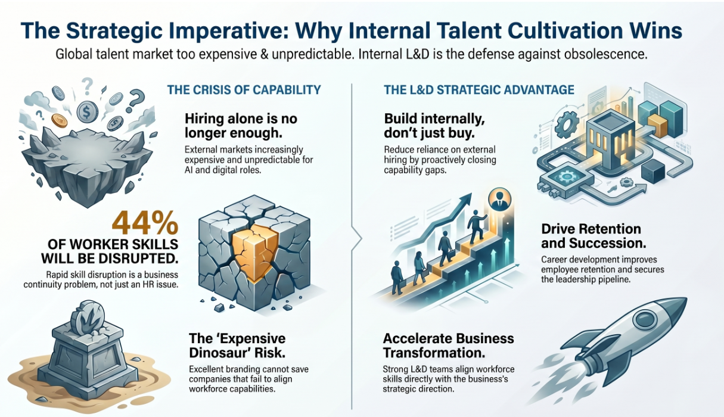
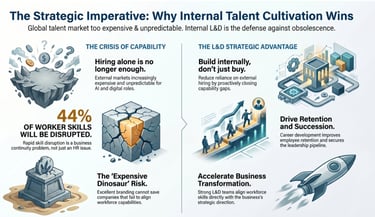
Here is the reality many executives are now facing: hiring alone cannot solve capability gaps anymore. The global talent market is increasingly competitive, expensive, and unpredictable. Roles involving AI, digital transformation, cybersecurity, analytics, and leadership capabilities are becoming harder to fill externally.
According to World Economic Forum Future of Jobs Report, nearly 44% of workers’ skills are expected to be disrupted within the next few years. The statistic is not an HR problem. It is a business continuity problem. This is where investing in capable L&D professionals becomes strategically important. In simple terms; they help businesses avoid becoming very expensive dinosaurs with excellent branding.
L&D Professionals Help Organisations Forecast the Future
One of the most overlooked strengths of modern L&D professionals is their growing role in workforce intelligence.
Good L&D teams do not just respond to training requests anymore. They analyse trends, identify capability risks, and help leaders understand where workforce readiness is heading. For example:
Which departments are lacking future-critical skills?
Which employees show potential for internal mobility?
Which capabilities are emerging faster than current learning paths?
What leadership skills will managers need as hybrid work evolves?
This level of insight allows organisations to move from reactive learning to strategic workforce planning. And in uncertain markets, organisations that can forecast workforce readiness gain a serious advantage.
Investing in L&D Professionals Also Improves Employee Trust
Employees today are paying close attention to one silent questions: “Can I still grow here?”
When organisations invest in developing their L&D teams, the quality of learning experiences improves across the company. Learning becomes more personalised, strategic, relevant, and connected to career growth. Employees notice that.
A well-supported L&D function creates:
Clearer development pathways
Better onboarding experiences
More relevant upskilling opportunities
Stronger leadership development
Improved learning engagement
And contrary to popular belief, employees do not leave organisations simply because of salary. Sometimes they leave because they cannot see a future version of themselves inside the company anymore.
The Organisations That Win Will Be the Ones That Learn Faster
Technology can be purchased. Software can be implemented. AI can be deployed. But organisations still need people who know how to help humans adapt to all of it.
That is where L&D professionals become invaluable.
Investing in L&D professionals is not about sending them to occasional certifications and hoping for the best. It is about recognising them as strategic business partners who influence workforce capability, organisational resilience, and long-term growth.
Because in a business moving at the speed of notifications, organisations cannot afford teams responsible for workforce development to operate with outdated skills, outdated tools, or outdated influence. The future of work will belong to organisations that learn faster than change arrives.
And behind every organisation that manages to do that successfully, there is usually a very tired but very strategic L&D professional quietly holding the whole capability puzzle together.
Till we meet again in the next episode!
About the author
Hazie Halim has more than 15 years of experience in Talent Management Solution and L&D Tech. Her approach has never been about the technology; it has always been about the people in the industry. She understands HR & L&D, she understands the pain and the stress, and she understands the fear and reluctance of system integration drama. Combining these has allowed her to be compassionate when sharing her experience and knowledge during project implementation. She is passionate about making the HR & L&D experts look good in front of their stakeholders. Their win is her win.


Unlock a world of thrilling content
Join our newsletter today
Resources


Unit 7.06, Level 7, Amcorp Trade Centre, 18, Persiaran Barat, 46050 Petaling Jaya, Selangor.
Nixfon (M) Sdn Bhd (633379-V)