
Is Kirkpatrick Model Still Relevant?
While the Kirkpatrick Model is decades old, its four-level framework remains one of the most powerful lenses for evaluating modern training. Too often, L&D gets stuck measuring empty completion rates and reaction forms while leaving business impact untracked. Read our guide to shifting from simple activity logging to outcome-based thinking, moving up the evaluation ladder to measure real behavioral change, and using data-driven insights to prove that learning is an investment rather than an expense.
Hazie Halim
7/7/20264 min read
What is the Kirkpatrick Model?
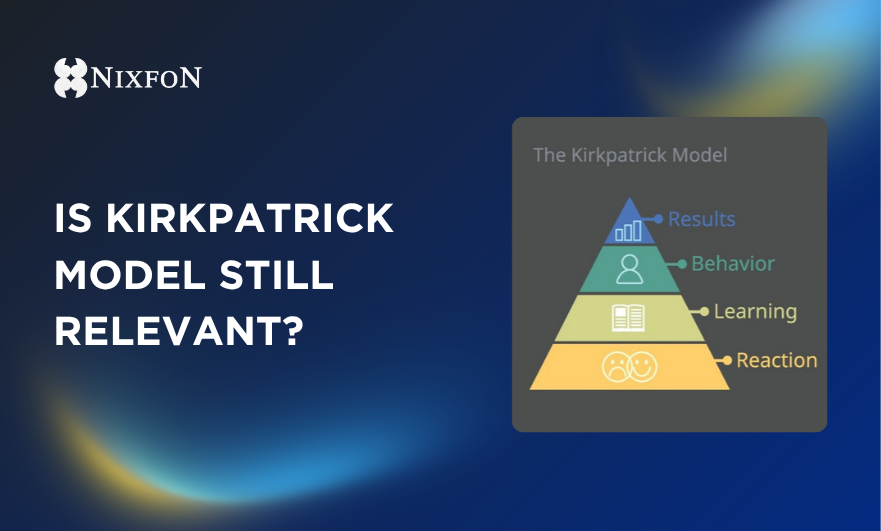
The Kirkpatrick Model is one of the most widely used frameworks for evaluating training effectiveness. Developed by Dr. Donald Kirkpatrick in the 1950s, it helps organisations measure learning outcomes across four levels.
Those four levels are:
Level 1: Reaction
How participants felt about the training. Did they find it useful? Engaging? Relevant?
Level 2: Learning
What participants actually learned. Did their knowledge or skills improve?
Level 3: Behaviour
Whether participants applied what they learned at work. Did their actions or habits change?
Level 4: Results
The ultimate business outcomes. Did the training improve productivity, quality, sales, or customer satisfaction?
Think of it as a ladder. Each level climbs closer to what organisations truly care about real-world impact.
Why This Model Is Still Important Today
Some people assume that because the Kirkpatrick Model is decades old, it might be outdated. In reality, the opposite is often true.
Many organisations still focus heavily on Level 1 and sometimes, Level 2. Feedback forms are collected. Knowledge quizzes are completed. Completion rates are reported.
But the real strategic value sits in Level 3 and Level 4. That is where learning connects with performance.
When L&D can demonstrate that training influences behaviour and contributes to business results, the conversation changes. Training stops being viewed as an expense. It becomes an investment.
How the Kirkpatrick Model Is Used in Practice
In most organisations, the evaluation process often looks something like this:
Level 1: Reaction – immediately after a workshop or module, participants complete a short survey. This helps understand their experience and whether the content felt relevant.
Level 2: Learning – knowledge checks, quizzes, or assessments measure what participants have absorbed.
Level 3: Behaviour – After some time has passed, managers or supervisors observe whether employees are applying the new skills in their work.
Level 4: Results – Performance indicators are reviewed to see whether improvements occurred. These could include increased sales, improved quality, reduced errors, or better customer satisfaction scores.
The beauty of the model lies in its simplicity. It reminds L&D teams to look beyond satisfaction and ask deeper questions.
How It Helps L&D Become More Strategic
The Kirkpatrick Model is not just an evaluation tool. It is a strategic lens. Here’s why:
1. It Encourages Outcome-Based Thinking
When L&D plans a program with the four levels in mind, the design becomes more intentional. Instead of asking “what content should we include?” the question becomes “what behaviour should change, and how will we measure it?”
This shift moves learning closer to performance.
2. It Strengthens Business Alignment
When training initiatives link directly to business metrics, leaders see the connection more clearly. For example:
Leadership training may aim to improve employee engagement
Sales training may target higher conversion rates
Customer service training may focus on reducing complaints
The Kirkpatrick framework helps connect learning activity with these outcomes.
3. It Builds Credibility for L&D
When L&D can say “After this program, managers conducted 30% more coaching conversations and employee engagement scores improved.”, that statement carries weight. It demonstrates that learning is not just happening. It is making a difference.
And credibility is one of the most valuable assets an L&D team can have.
A Gentle Reality Check
Applying the full Kirkpatrick Model is not always easy. Levels 3 and 4 requires collaboration with managers, access to performance data, and patience. Behaviour change takes time, and business results rarely come from training alone.
But that does not make the model loses its value. Even partial application can significantly improve how L&D designs and evaluates programs. Sometimes, the biggest shift comes from simply asking better questions before a program begins.
When L&D begins to measure and design learning with those outcomes in mind, something interesting happens. Training stops being an event. It becomes a catalyst for performance.
And that is where L&D begins to earn its seat at the strategic table.
How Nixfon Learning Supports Kirkpatrick Model Application
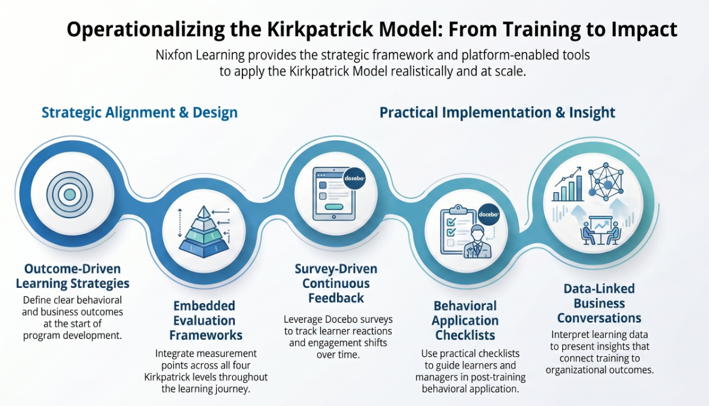
At Nixfon Learning, we understand that while the Kirkpatrick Model is simple in concept, applying it meaningfully within an organisation requires structure, consistency, and the right tools.
Many L&D teams recognise the importance of measuring beyond satisfaction and completion. However, translating Levels 3 and 4 into practical, trackable actions can often feel complex. This is where we provide both strategic guidance and platform-enabled support.
We partner with organisations to operationalise the Kirkpatrick Model in a way that is realistic, scalable, and aligned with business outcomes.
We recognise that applying the Kirkpatrick Model is not about measuring everything perfectly. It is about measuring what matters, consistently and meaningfully.
At Nixfon Learning, we help organisations move from collecting feedback to generating insight, so that learning is not only delivered, but demonstrated to make a real impact where it counts most.
Till we meet again in the next episode!
About the author
Hazie Halim has more than 15 years of experience in Talent Management Solution and L&D Tech. Her approach has never been about the technology; it has always been about the people in the industry. She understands HR & L&D, she understands the pain and the stress, and she understands the fear and reluctance of system integration drama. Combining these has allowed her to be compassionate when sharing her experience and knowledge during project implementation. She is passionate about making the HR & L&D experts look good in front of their stakeholders. Their win is her win.


Unlock a world of thrilling content
Join our newsletter today
Resources


Unit 7.06, Level 7, Amcorp Trade Centre, 18, Persiaran Barat, 46050 Petaling Jaya, Selangor.
Nixfon (M) Sdn Bhd (633379-V)