Learning in the Flow of Work
Traditional training forces employees to step away from their tasks, creating a constant competition between learning and actual work. Learning in the flow of work completely shifts this design—bringing support, digital nudges, and practical job aids directly into everyday tasks. Read our guide to reducing your dependency on formal courses, integrating performance tools into daily workflows, and transforming L&D from an isolated content creator into a vital performance enabler.
Hazie Halim
7/2/20264 min read
When Learning Stops Competing with Work
Let’s begin with a familiar scene.
An employee receives a notification – “Mandatory training: 2-hour module due this week.” They sigh. Not because learning is unimportant, but because of the timing feels, inconvenient. There are emails waiting, a client meeting in 30 minutes, and a report due before the end of the day.
So, the training is opened in one tab while work continues in another. The module progresses, but the mind is elsewhere.
This is not a motivation issue. This is a design issue.
For many organisations, learning still happens outside the rhythm of work. Employees must step away from their tasks to complete courses that may or may not help them in the moment they need support.
Learning in the flow of work takes a different approach.
Instead of pulling employees away from work to learn, it brings learning closer to where work actually happens.
What Is Learning in the Flow of Work
Learning in the flow of work means embedding support, guidance, and knowledge directly into everyday tasks.
Instead of long training sessions scheduled weekly in advance, employees receive learning at the moment of need. When they are:
Preparing for a client conversation
Navigating a new system
Giving feedback to a team member
Solving a problem they have not encountered before
In these moments, people do not need a full course. They need help. And help, when delivered quickly and clearly, becomes learning.
Workflow-Integrated Learning
Workflow-integrated learning connects learning resources directly to the tools and platforms employees already use. For example:
A short guidance prompt appears within a CRM system when handling customer objections.
A leadership tip appears before a performance review conversation.
A quick walkthrough appears when an employee uses a new digital tool for the first time.
The learning does not interrupt work. It supports it. This approach respects a simple reality: employees are busy. The closer learning sits to their daily tasks, the more likely it will be used.
Performance Support Tools
Performance support tools are practical resources that help employees perform tasks effectively in real time. Examples include:
Quick reference guides
Decision frameworks
Step-by-step checklists
Short explainer videos
Searchable knowledge bases
These tools focus on doing, not just knowing. Think of a sales representative preparing for a difficult negotiation. A short negotiation framework or objection-handling guide can provide immediate clarity. The learning happens through application, not theory.
The Power of Job Aids
Job aids are one of the most underestimated learning tools. They are simple, practical, and highly effective.
A well-designed job aid might include:
A conversation structure for managers giving feedback
A checklist for safety procedures
A guide for conducting a client discovery meeting
Unlike traditional training materials, job aids remain accessible long after the training session ends. They act as quiet companions during real work situations.
Sometimes, the most powerful learning solution is not a course. It is a well-designed one-page guide.
Digital Nudges: Small Reminders, Big Impact
Another powerful approach is the use of digital nudges. Digital nudges are small prompts that encourage behaviour at the right moment. For example:
A reminder to ask open-ended questions during a sales call
A quick leadership reflection at the start of the week
A prompt encouraging managers to give recognition to their teams
These nudges reinforce learning through gentle repetition. They are not overwhelming; they are subtle signals that guide behaviour over time.
Small nudges often create lasting habits.
Reducing Dependency on Formal Courses
Formal training still has an important role. Complex topics, foundational knowledge, and leadership development often require structured programs. But many everyday challenges do not require a full course. They require clarity at the right moment.
Reducing dependency on formal courses allows L&D to focus its resources where structured learning truly adds value. It also helps employees feel supported rather than overloaded.
Because sometimes, the best learning experience is not another module. It is a helpful answer at exactly the right time.
The Strategic Role for L&D
For L&D professionals, embracing learning in the flow of work requires a shift in thinking. Instead of asking “what course should we design?”, the question becomes “what support do employees need while they are working?”
This shift moves L&D from content creators to performance enablers. It requires understanding real work challenges, collaborating closely with business teams, and designing tools that solve problems quickly.
It also strengthens L&D’s strategic role. When learning solutions help employees perform better immediately, their value becomes visible.
How Nixfon Learning Supports Learning in the Flow of Work
At Nixfon Learning, we understand that learning is most effective when it feels like support, not interruption. Designing learning in the flow of work requires more than adding resources into systems. It requires a strategic shift in how organisations think about learning, performance, and daily work.
We partner with organisations to move beyond traditional training models and design learning experiences that integrate naturally into everyday workflows.
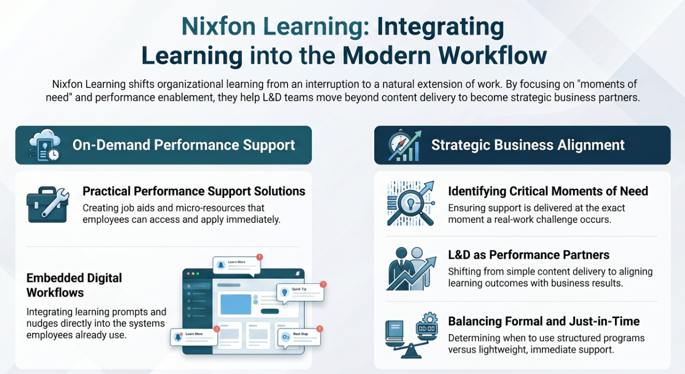
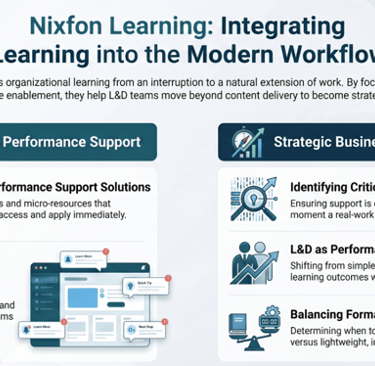
We recognise that learning in the flow of work is not about reducing learning. It is about placing it where it matters most.
At Nixfon Learning, we help organisations design learning experiences that feel less like a separate activity and more like a natural extension of work itself, where support appears at the right moment, and learning quietly becomes part of how people succeed every day.
Till we meet again in the next episode!
About the author
Hazie Halim has more than 15 years of experience in Talent Management Solution and L&D Tech. Her approach has never been about the technology; it has always been about the people in the industry. She understands HR & L&D, she understands the pain and the stress, and she understands the fear and reluctance of system integration drama. Combining these has allowed her to be compassionate when sharing her experience and knowledge during project implementation. She is passionate about making the HR & L&D experts look good in front of their stakeholders. Their win is her win.


Unlock a world of thrilling content
Join our newsletter today
Resources


Unit 7.06, Level 7, Amcorp Trade Centre, 18, Persiaran Barat, 46050 Petaling Jaya, Selangor.
Nixfon (M) Sdn Bhd (633379-V)