Skills-Based Organisation – Why Now?
Roles evolve faster than job descriptions can keep up, making traditional job titles a poor measure of what your workforce can actually achieve. Transitioning into a Skills-Based Organisation (SBO) shifts the focus from rigid boxes to dynamic, measurable capabilities. Read our guide to breaking down role silos, overcoming adoption barriers, and creating a highly agile learning ecosystem that prioritizes skills over titles.
Hazie Halim
7/16/20264 min read
There was a time when job titles were enough. If someone was a “Marketing Manager” or “Finance Analyst”, we assumed we understood what they could do, what they needed to learn, and where they might go next.
Today, that assumption feels, slightly optimistic.
Roles evolve faster than job descriptions can keep up. Skills that were relevant three years ago may now need refreshing. And organisations are finding that what people can do matters far more than what their title says.
This is why many organisations are beginning to explore the idea of a Skills-Based Organisation (SBO). Not as a trend, but as a necessary shift.
What is a Skills-Based Organisation?
A Skills-Based Organisation focuses on identifying, developing, and deploying skills across the workforce, rather than relying solely on job titles or traditional role structures.
Instead of asking “what role does this person have?”, the organisation begins asking “what skills do we have today?”, “what skills do we need tomorrow?”, and “how do we bridge the gap?”.
Skills become the common language across learning, talent, and business strategy. It is less about the box someone sits in, and more about the capabilities they bring to the table.
The Goals of an SBO
At its core, an SBO is not about replacing job titles. It is about creating a more flexible and responsive organisation. Some of the key goals include:
Improving workforce agility – Employees can move across roles and projects based on skills, not just titles
Closing skill gaps faster – Organisations can identify gaps early and respond with targeted learning
Supporting internal mobility – Employees can explore new opportunities without being limited by rigid role structures
Aligning learning with business needs – Learning initiatives become directly tied to capability development
In short. SBO helps organisations become better at adapting, which is increasingly the one skill every organisation needs.
The ROI of Skills-First Approach
The return on a skills-based approach is not always measured in a single metric. It often shows up across multiple areas of the organisation. For example:
Reduced hiring costs through internal mobility
Faster time to capability when employees are reskilled effectively
Higher employee engagement as individuals see clearer growth opportunities
Better workforce planning based on real capability data
There is also a quieter, but equally important return. When employees feel that their skills are recognised and developed, they tend to feel more valued. And when people feel valued, they tend to stay.
Which, from both a human and business perspective, is usually a good outcome.
Challenges and Barriers to SBO Adoption
While the idea of an SBO is appealing, the path toward it is not always straightforward. Organisations often encounter a few common challenges:
Unclear definition of skills – Different departments may define skills differently, making alignment difficult
Lack of visibility into existing capabilities – It is not always easy to know what skills currently exist within the workforce
Technology limitations – Traditional systems may not support skills mapping or dynamic learning pathways
Change resistance – Shifting from role-based thinking to skills-based thinking requires a mindset change across the organisation
And occasionally, there is a quiet concern of “This sounds promising, but where do we even begin?”.
From Challenge to Solution
The good news is that SBO adoption does not require an overnight transformation. In fact, the most effective approaches are often gradual and practical. Organisations can begin by:
Defining a simple skills framework aligned with key business priorities
Mapping existing learning content to these skills
Introducing skills-based learning pathways
Building visibility into workforce capabilities over time
Some steps create clarity. And clarity builds momentum.
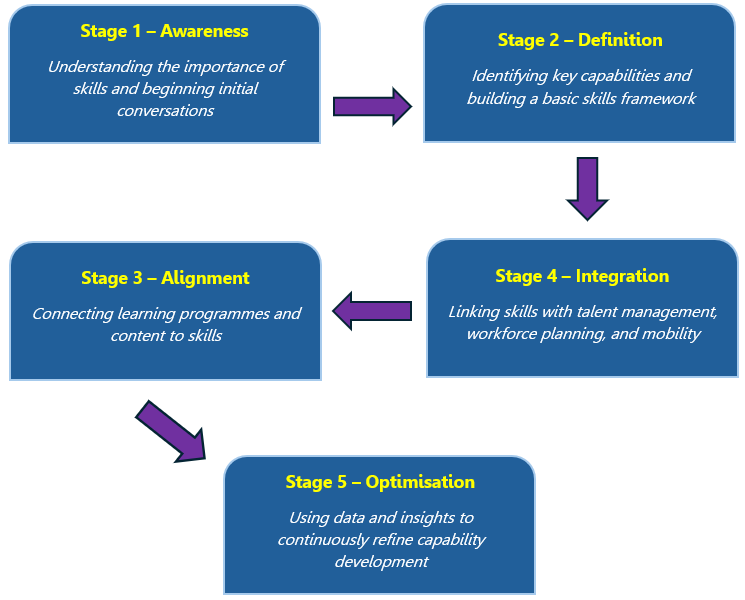
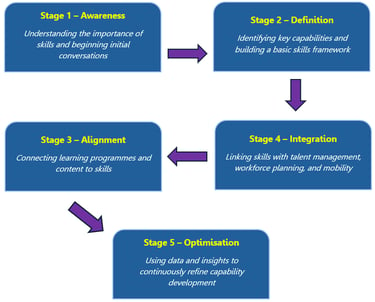
A Roadmap to SBO Maturity
While every organisation’s journey will look slightly different, SBO adoption often evolves through stages.
Progression does not need to be perfect. What matters is moving toward with intention.
How Nixfon Learning Support SBO Adoption
At Nixfon Learning, we work closely with organisations to turn the concept of a Skills-Based Organisation into a practical and sustainable approach. Our role is to help organisations move from theory to execution by:
Designing capability and skills frameworks aligned with business goals
Mapping learning strategies to skills-based development journeys
Supporting governance and alignment across L&D, HR, and leadership
Helping organisations embed skills into their broader learning ecosystem
With the support of Docebo 365Talents, organisations can further strengthen this journey. The platform enables:
AI-driven skills identification and mapping
Real-time visibility into workforce capabilities
Personalised learning and career recommendations
Internal mobility based on skills rather than job titles
This creates a connected environment where learning, talent, and business strategy come together.
Why Now?
The question is no longer whether organisations should consider a skills-based approach. It is whether they can afford not to.
As work continues to evolve, organisations that understand and develop their workforce capabilities will be better positioned to adapt, grow, and navigate change. And while the journey toward an SBO may feel complex at times, it often begins with a simple shift in thinking: from job titles to skills.
And from there, everything else begins to follow.
Till we meet again in the next episode!
About the author
Hazie Halim has more than 15 years of experience in Talent Management Solution and L&D Tech. Her approach has never been about the technology; it has always been about the people in the industry. She understands HR & L&D, she understands the pain and the stress, and she understands the fear and reluctance of system integration drama. Combining these has allowed her to be compassionate when sharing her experience and knowledge during project implementation. She is passionate about making the HR & L&D experts look good in front of their stakeholders. Their win is her win.


Unlock a world of thrilling content
Join our newsletter today
Resources


Unit 7.06, Level 7, Amcorp Trade Centre, 18, Persiaran Barat, 46050 Petaling Jaya, Selangor.
Nixfon (M) Sdn Bhd (633379-V)